Update: July 13, 2026
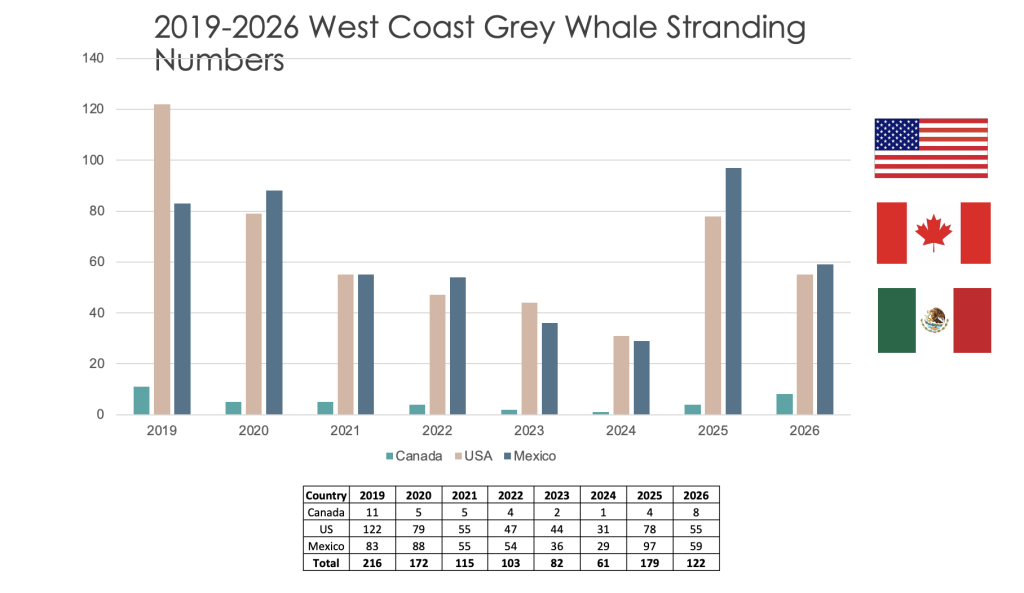
Number of Grey Whales known to have stranded throughout their range in 2026: 145 (NOAA, up to July 6th for Mexico, Canada, and the United States). These are only the known dead. It is estimated that the ratio between known mortalities of Grey Whales and unobserved mortalities is between 1 to 7 and 1 to 25. For the 145 known mortalities for 2026 to date, the actual total may be between 1,015 and 3,625. If the 179 known dead in 2025 are considered, the actual mortalities are estimated to be between 2,268 and 8,100. Source: Perkins, T. (2026). Pacific gray whales facing ‘catastrophic’ die-off as climate crisis hits food supply
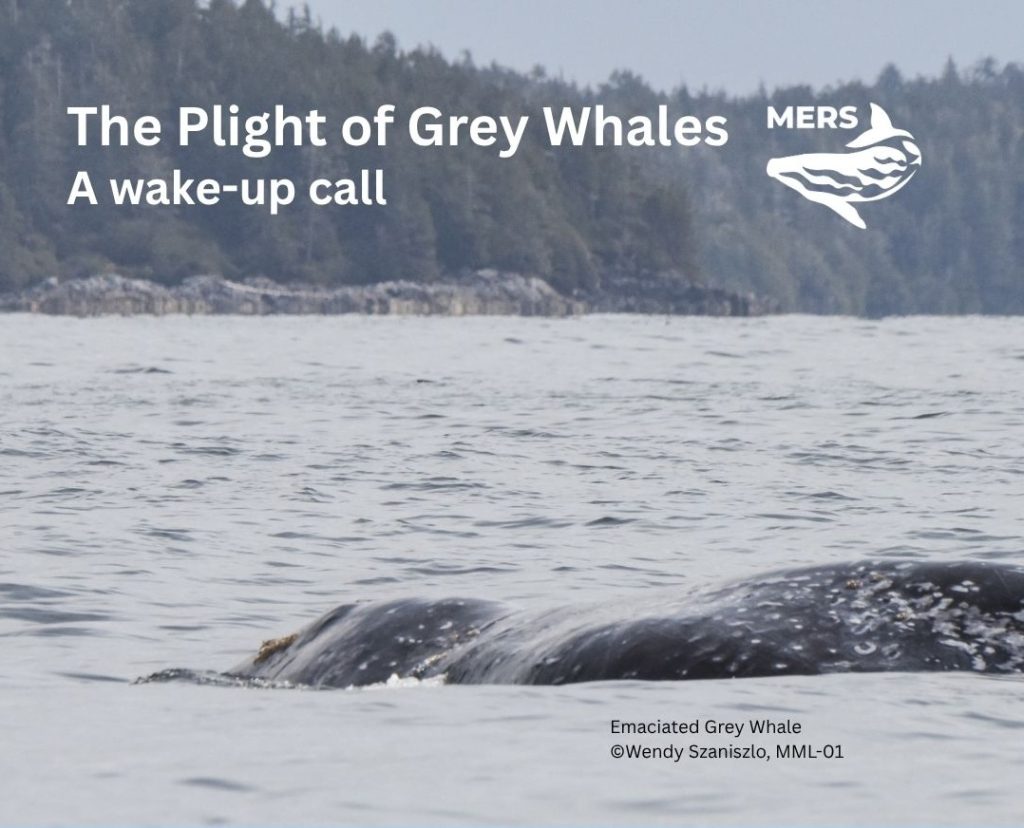
The content below is a follow-up to the May 27, 2026, webinar entitled “The Plight of Grey Whales – A wake-up call”. There is great concern about the number of Grey Whale deaths, how many are malnourished, and low calving rates have persisted for years. For a summary of the concerns, please see our resource at this link.
We are very grateful to those who generously shared their expertise in the webinar, and to everyone who attended.
The recording of the webinar is provided below. The content includes how Grey Whales, despite the magnitude of urgent concerns, are currently not appropriately protected in Canada. Please see the text below, adapt it as you see fit and send it to the Canadian Minister of Fisheries and your Member of Parliament (MP).
MERS Call to Action
The text below can be adapted as you see fit and emailed to:
- The Honourable Joanne Thompson (Minister of Fisheries, Government of Canada)
DFO.Minister-Ministre.MPO@dfo-mpo.gc.ca. - And your Member of Parliament – their email address can be found at this link.
Suggested subject line:
Grey Whales Must Urgently Receive Endangered Species Protection
To the Honourable Joanne Thompson,
This is to express my great concern about the plight of Grey Whales on Canada’s Pacific Coast and the inadequacies of the Government of Canada’s response to the recommendations by the Committee on the Status of Endangered Wildlife in Canada (COSEWIC), and its failure to address rapidly escalating threats to species-at-risk. The Government must urgently advance endangered species listing and protections for Grey Whales.
In 2017, COSEWIC recommended that the Grey Whales be recognized as three populations of which two should receive protection as endangered under Canada’s Species at Risk (SARA) – the Pacific Coast Feeding Group and Western Pacific Population. Nine years have passed without the Government accepting this recommendation. This is unacceptable.
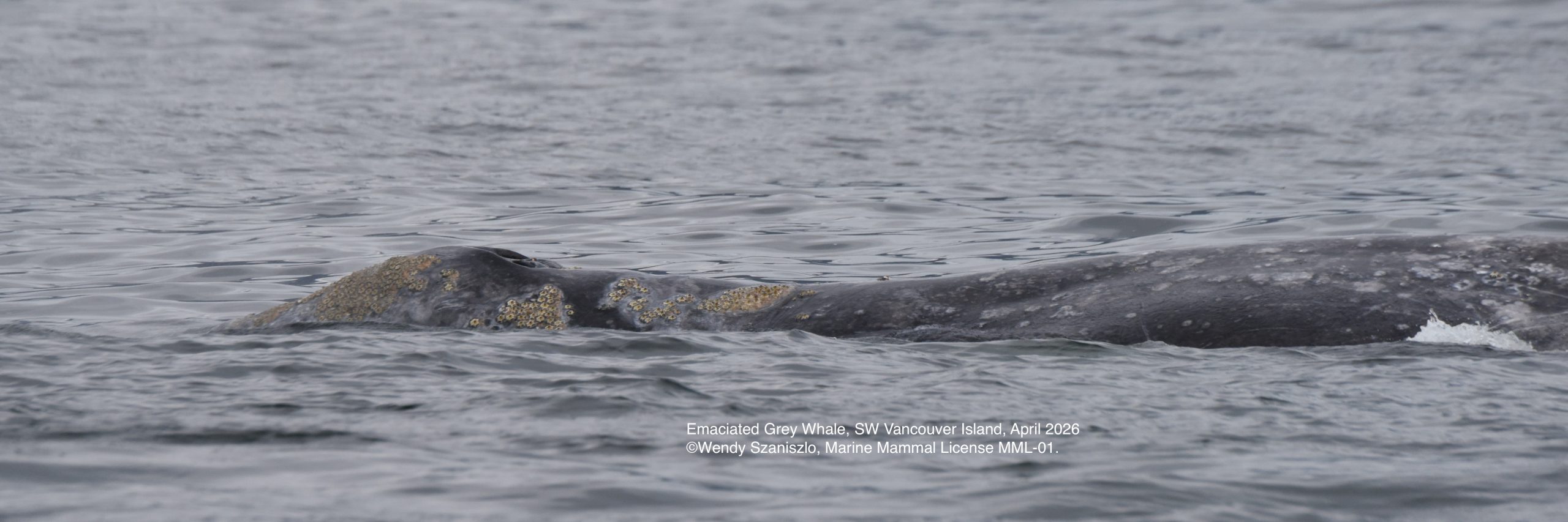
Years of delay have left Grey Whales increasingly vulnerable. Since the 2017 COSEWIC recommendations, the third population – the Northern Pacific Migratory Population – has crashed, with many individuals showing signs of severe emaciation and calving rates at the lowest on record. This is supported by necropsy results and field observations and has led to Grey Whale researchers calling for action. This includes the open letter from Drs. Jim Darling, Jorge Urbán Ramírez, and Steven Swartz.
The leading hypothesis for what is happening is that these Grey Whales that migrate to the feeding grounds in the Arctic (northern Bering and Chukchi seas) are not getting enough food due to environmental variation linked to climate change. When emaciated, they are more vulnerable to additional threats such as vessel strike.
The Grey Whales of the Northern Pacific Migratory population MUST ALSO receive protection as an endangered population.
I am adding my voice to those calling on the Government of Canada to:
- Accept the 2017 recommendations by COSEWIC that the Grey Whales of the Pacific Coast Feeding Group and Western Pacific populations are endangered so they receive the legislated protections urgently needed to mitigate threats.
- Support an emergency assessment of the Grey Whales in the Northern Pacific Migratory Population leading to rapid protection under the Species at Risk Act.
- Expedite endangered listing decisions and precautionary measures for species-at-risk. This has become even more essential due to how quickly the well-being of species can deteriorate due to climate change.
For details, I refer you to the Marine Education and Research Society’s resource Sounding the Alarm for North Pacific Grey Whales.
Our rapidly changing climate requires a far more responsive and timely process for defining and protecting species-at-risk in Canada. We call for immediate action to protect the Grey Whales of the Pacific Coast.
Respectfully,
[Your name]
Recording of the May 27, 2026 Webinar
Text provided in promotion of the webinar:
Thank you so much for your interest in the well-being of Grey Whales, and the concerns about the number found dead and emaciated, and the increased risk of collision.
Hosts will be Caitlin Birdsall and Jackie Hildering from the Marine Education and Research Society (MERS), and we are very grateful that the following speakers will share their expertise:
John Calambokidis is the senior Research Biologist and founder of the Cascadia Research Collective. Cascadia’s work includes conducting necropsies on the Grey Whales found dead in Washington State waters. Please see below for more details about John’s background. He will share an overview of Cascadia’s Grey Whale research and findings from the necropsies.
Wendy Szaniszlo conducts Grey Whale research with Fisheries and Oceans Canada’s (DFO) Cetacean Research Program. She has been involved in Grey Whale studies for 20 years in collaboration with other government agencies, universities, and research groups. Wendy will provide an overview of the work DFO is conducting on Grey Whale conservation in British Columbia.
Paul Cottrell is Fisheries and Oceans Canada’s Marine Mammal Coordinator on the Pacific coast. Paul will be sharing what is known of the known dead Grey Whales off the coast of B.C.
Mark Sawyer and Ashley Hoyland are based on southwest Vancouver Island, B.C., and work with the community there to catalogue Humpbacks and Grey Whales as “Whales of Clayoquot and Barkley“. They are MERS Research Associates and will speak about their photogrammetry research to assess the body condition of Grey Whales.

Learn more about the Cascadia Research Collective’s Gray Whale research:
- Gray Whale population and feeding studies
- End of year report to learn more about the breath of Cascadia’s work
- Join Cascadia’s mailing list to stay up to date about our work and the status of whales in the North Pacific
- Support Cascadia’s work and help protect whales through a one-time or monthly donation