The following is a resource on the plight of Grey Whales in the North Pacific. It will be updated when there are developments. Last updated: July 12, 2026. Please also see our call to action for Grey Whales to receive protection as endangered species.
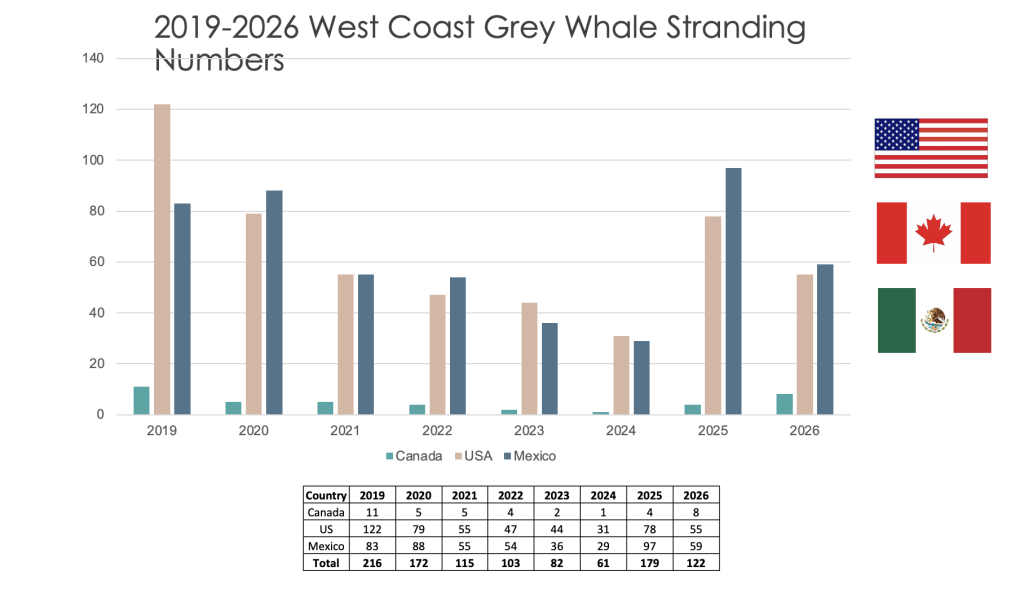
Number of Grey Whales known to have stranded throughout their range in 2026: 145 (NOAA, up to July 6th for Mexico, Canada, and the United States). These are only the known dead. It is estimated that the ratio between known mortalities of Grey Whales and unobserved mortalities is between 1 to 7 and 1 to 25. For the 145 known mortalities for 2026 to date, the actual total may be between 1,015 and 3,625. If the 179 known dead in 2025 are considered, the actual mortalities are estimated to be between 2,268 and 8,100. Source: Perkins, T. (2026). Pacific gray whales facing ‘catastrophic’ die-off as climate crisis hits food supply
Summary
The majority of Grey Whales found in the North Pacific belong to the “Northern Pacific Migratory” population, as defined by the Committee on the Status of Endangered Wildlife in Canada (COSEWIC, 2017). These Grey Whales breed in Mexico and travel to the Arctic to feed. Once thought to be a conservation success story due to population rebound after commercial whaling, an alarm is now being sounded by Grey Whale researchers due to significant, rapid changes to this population.
There has been an awakening to the plight of these Grey Whales due to the number found dead in British Columbia waters recently. But it is important to know that concern about the number of Grey Whale deaths, how many are malnourished, and low calving rates have persisted for years.
The concern is so great that three leading Grey Whale biologists wrote a call to action in August 2025 entitled, “Concern for the Future of Gray Whales“. We include excerpts from that letter below.
The leading hypothesis for what is happening regarding declines in calving rates, increased deaths, and numbers of emaciated whales is that the Grey Whales that migrate to the feeding grounds in the Arctic (northern Bering and Chukchi seas) are not getting enough food due to environmental changes related to climate change – changes in sea ice cover, phytoplankton and sea ice-algae production that impact their prey. Grey Whales feed in the sand on species like ghost shrimp, polychaete worms, and amphipods.
The Grey Whales still migrate to the breeding lagoons in Mexico. But, without sufficient reserves, they are not equipped to deal with the winter fast, which can impact reproductive success, and they may not make it back to the feeding grounds in the Arctic and die along the migratory route.
When whales are emaciated, they are often more difficult to detect, making them more susceptible to vessel strike. Grey Whales are already at high risk of collision due to often feeding and travelling near shore. When emaciated, the lack of blubber makes them less buoyant, whereby they are lower in the water, and their blows are likely to be less pronounced too when the animals are weaker.
Some Whales Need Even More Space
The photos below show how emaciated some Grey Whales are. With so little blubber, there is a depression between the bones of the skull and shoulder blades. The shoulder blades and spine are also visible.
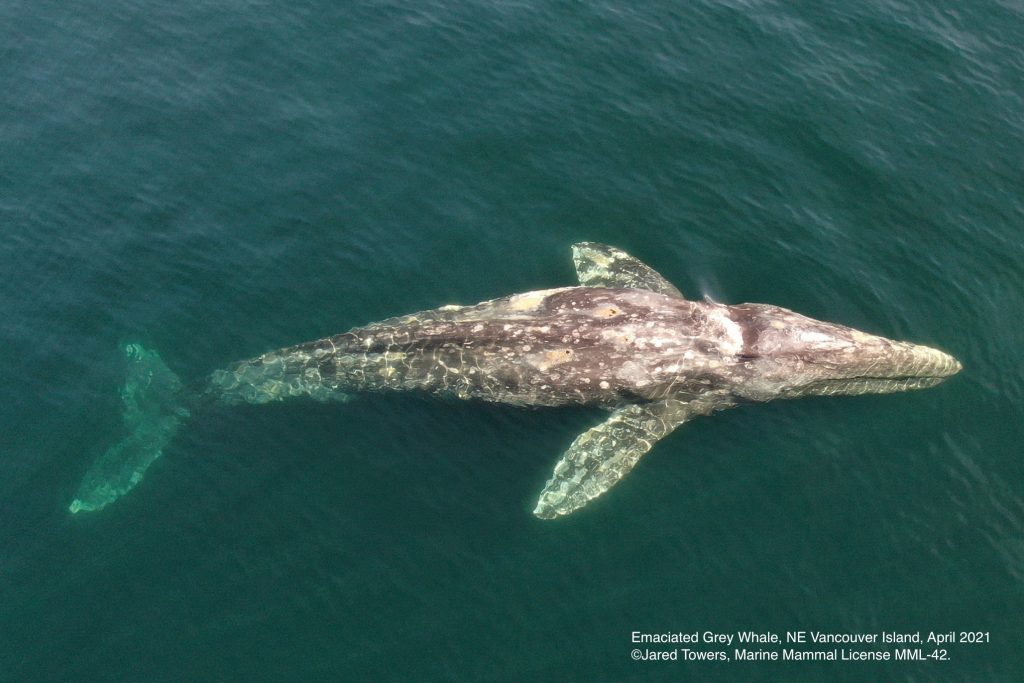
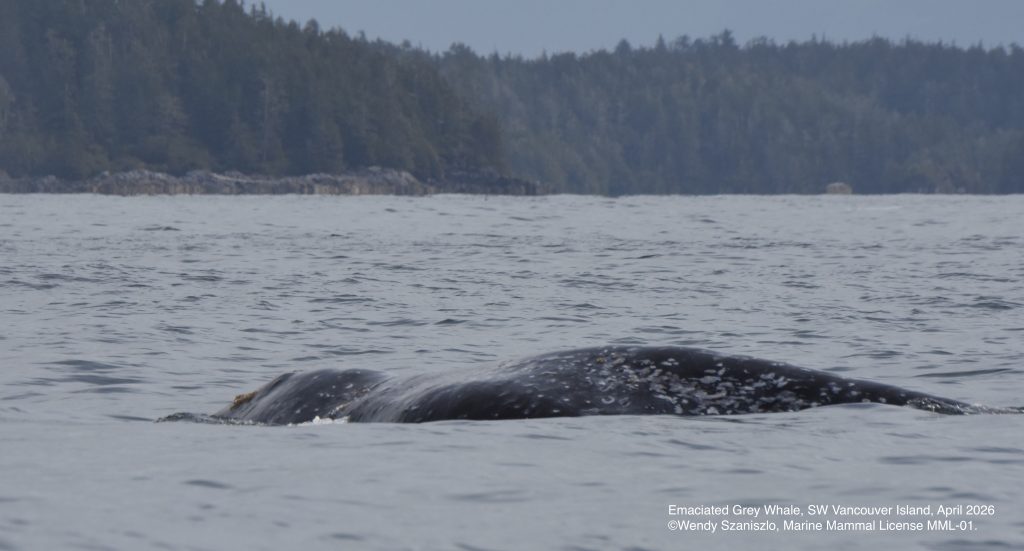
Please be alert for whales and report any dead, injured, or otherwise distressed whales to the DFO Incident Reporting Line at 1-800-465-4336.
But also, with so many of these whales suffering from nutritional stress, they need more space. Please help by contributing to a culture of Whale-Safe Boating – one in which it is understood why legal avoidance distances exist and the importance of increasing distance when whales may be stressed.
The legal minimum avoidance distance from Grey Whales is 100 metres, or 200 metres if the whale is resting or with a calf. However, because so many Grey Whales are not doing well, the most precautionary choice is to maintain a distance of at least 200 metres.
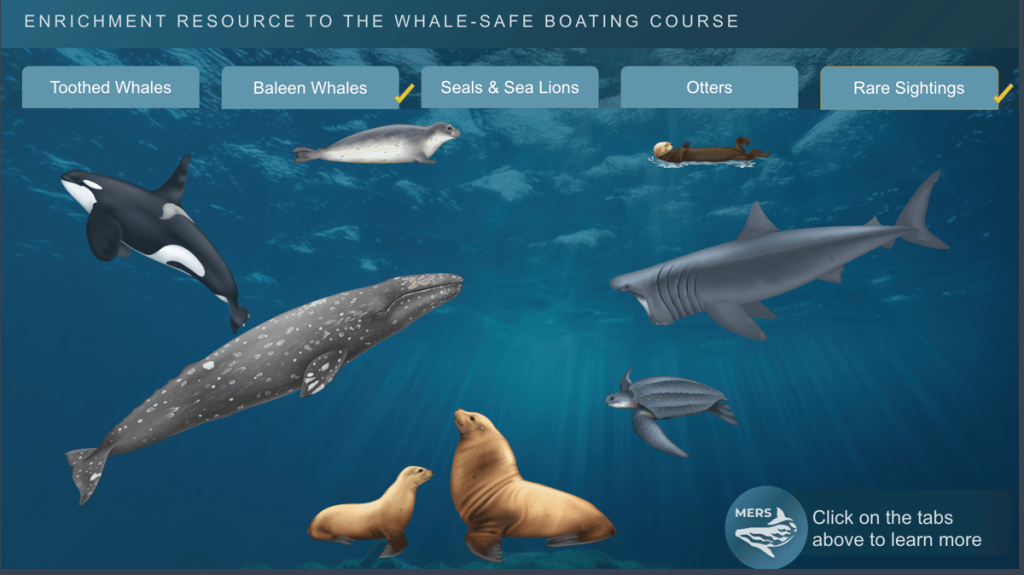
To learn more about what helps with the conservation of marine mammals and boater safety, please take our free online Whale-Safe Boating Course. It includes an enrichment resource on the identification and behaviour of coastal marine megafauna.
Excerpts From the Letter by Three Grey Whale Biologists – Drs. Jim Darling, Jorge Urbán Ramírez, and Steven Swartz
[Note: What is referenced as the Northern Pacific Migratory population in Canada is referenced as the Eastern North Pacific (ENP) population in the United States.]
From the letter:
“… things have changed dramatically in a very short period. Recent concern for the ENP gray whale population began in 2018 when researchers in Mexico noted a decline in the number of female whales with calves of the year, an increase in the proportion of the whales that were “skinny” and undernourished and increasing numbers of stranded dead whales in their winter breeding and calving areas in Mexico’s Baja Peninsula (Urban et al., 2019; Lobo-Barrera et al., 2024).
By 2019, strandings of gray whales increased significantly throughout their range along the North American Pacific coast, prompting the US National Oceanic and Atmospheric Administration (NOAA) to declare an “Unusual Mortality Event” (UME) for gray whales, which was considered over by 2023 (NOAA, 2023). However, the die-off has continued through 2024 and 2025. NOAA estimated that the ENP gray whale population declined from an estimated 26,960 whales in the 2015/2016 winter to 14,525 by the 2023/2024 winter, and then continued to decline to an estimated 12,950 whales in 2024/2025 (Eguchi et al., 2023, 2025).
The whales’ reproductive rates continued to decline in 2024 and 2025 winters, with only a handful of calves reported in the winter aggregation areas and lagoons (Martinez et al., 2025) and the lowest count of only 85 mother-calf pairs ever recorded during the spring northward migration of 2025 for this population (Lang et al., 2025) …
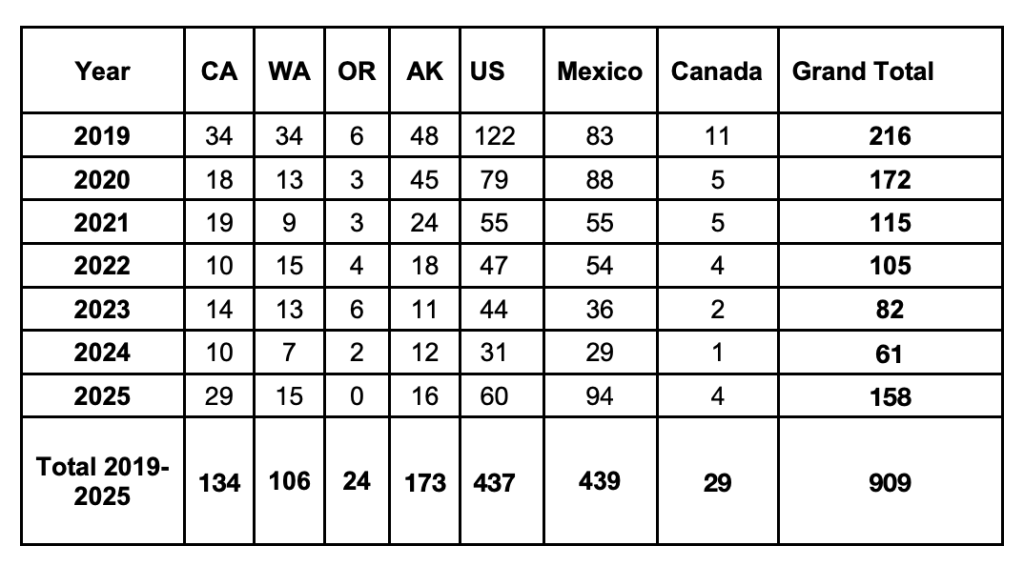
The most likely cause of this pending crisis is large-scale ecosystem change in sub-Arctic and Arctic feeding grounds, which are critical to most of the ENP gray whale population. Earlier research suggested a connection between the numbers of gray whales and changes in Arctic Sea ice. At that time, this was believed to be the primary environmental factor influencing the population’s growth (Perryman et al., 2002). Recent research indicates that the whales may be encountering unprecedented climate-change driven conditions in the Arctic that are impacting the annual availability of prey species, forcing the population to adjust to conditions it has not experienced before (Bindoff et al., 2019; Moore et al., 2022).
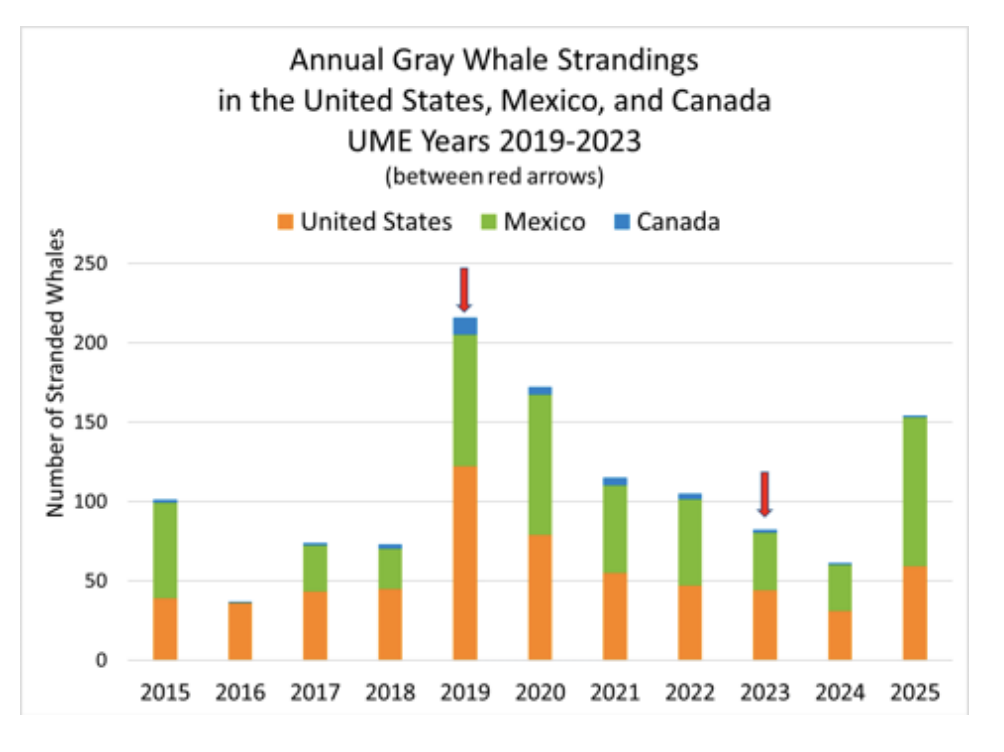
In summary, today, the gray whales are in precipitous decline, with significant range-wide die-offs, malnourished “skinny” individuals, and reduced reproductive rates. The best available analysis suggests a decrease in critical food species resulting from large-scale ecological changes in traditional Arctic summer feeding grounds. Without sufficient food during the summer, gray whales do not have the energy reserves necessary to compensate for the winter fast and to reproduce successfully.
We wish to emphasize that the ENP gray whales are the only remaining viable population of this species (and, indeed, the entire Mysticete family, Eschrichtiidae). Coastal bays and lagoons along the Pacific coast of the Baja California peninsula are the only known winter aggregation, breeding and calving area of this species. As such, we believe, based on the evidence of the last few years and with a reasonable degree of caution, that this species should be considered highly vulnerable, and every effort to protect it is warranted.
We urge an international review and assessment of gray whale biology and management to be undertaken by the Scientific Committee of the International Whaling Commission or other appropriate body. We further appeal to the International Union for the Conservation of Nature (IUCN) and other agencies to reassess the protection status for this species especially considering the environmental changes affecting their prey and the challenges this poses for rebounding from this most recent decline.”
Abundance and Number of Calves
The following graph is from NOAA Fisheries and shows that in 2025, there was the lowest known count of Grey Whale calves since 1994.
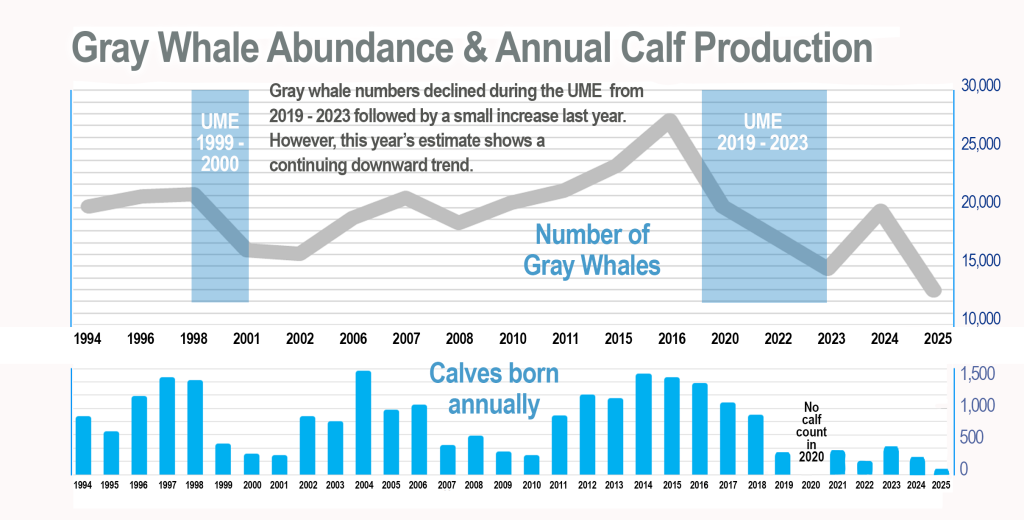
UME = Unusual Mortality Event.
Protection Under Canada’s Species at Risk Act
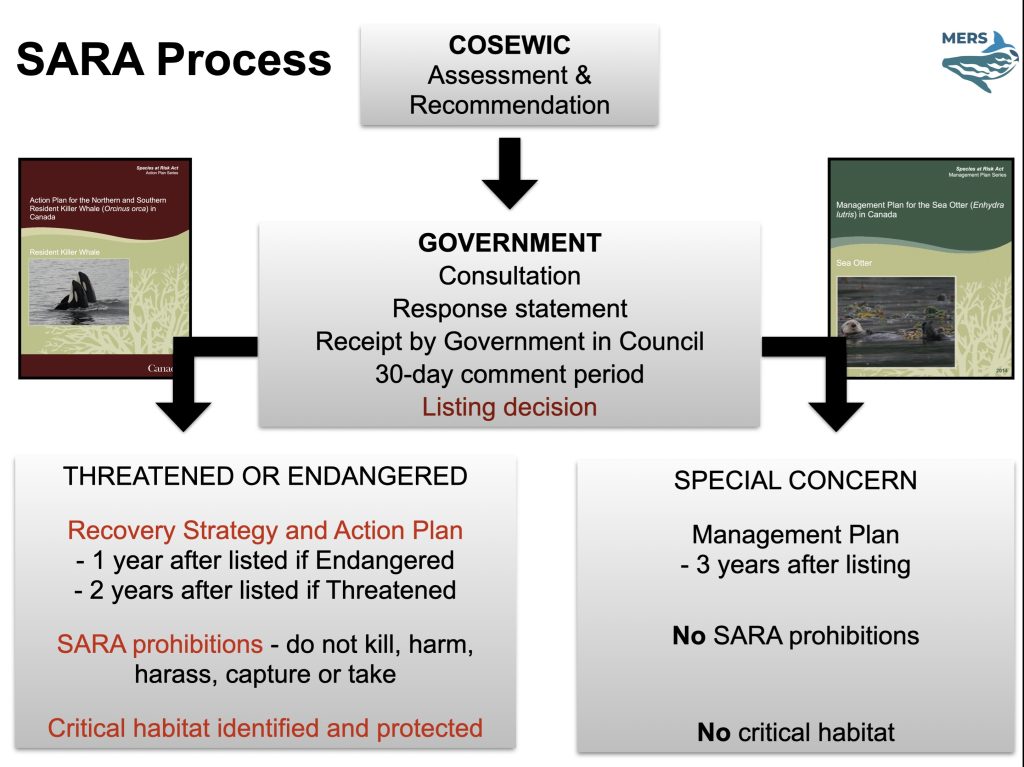
All Grey Whales in Canada are currently managed as one population under Canada’s Species at Risk Act (SARA) with the status “Special Concern“. In 2017, the Committee on the Status of Wildlife in Canada recommended to the Government of Canada that Grey Whales be protected as three populations of which two be recognized as “Endangered.”
- Pacific Coast Feeding Group population – recommendation of Endangered by COSEWIC in 2017
- Western Pacific population – recommendation of Endangered by COSEWIC in 2017
- Northern Pacific Migratory population – recommendation of Not At Risk by COSEWIC 2017 but this is now the population about which there are also extreme concerns as described above.
To date, there has been no decision about the recommendations by the Government of Canada. Note from our graphic below that, under the Species at Risk Act, there are very significant differences in protection depending on if a population or species is recognized as Special Concern versus Threatened or Endangered.
Sources
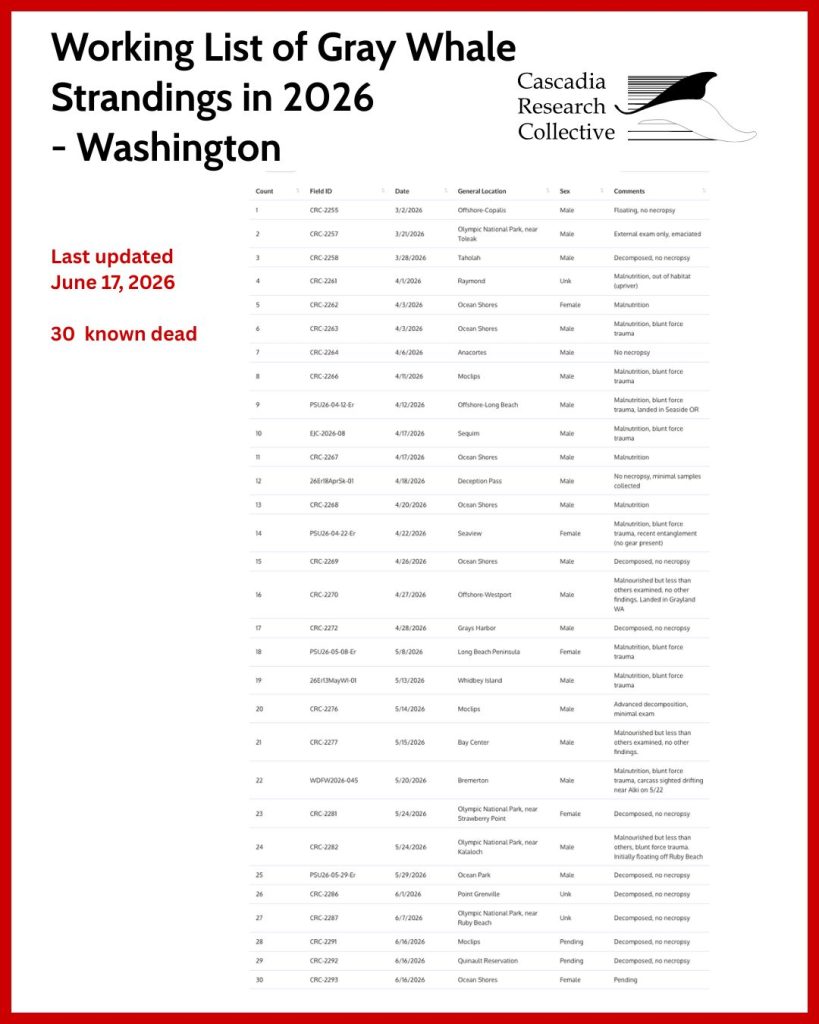
- Cascadia Research Collective. 2026. Working List of Gray Whale Strandings in 2026
- COSEWIC. 2017. COSEWIC assessment and status report on the Grey Whale Eschrichtius robustus, Northern Pacific Migratory population, Pacific Coast Feeding Group population and the Western Pacific population, in Canada. Committee on the Status of Endangered Wildlife in Canada. Ottawa. xxi + 74 pp.
- Darling, J. D., Swartz, S. L., & Urbán Ramírez, J. (2025, August 14). Concern for the future of gray whales. Gray Whale Research in Mexico.
- Darling, J. D., & Calambokidis, J. (2025, April 13). Gray whale chronicles: Past and present stories from the field [Video]. YouTube.
- Moore, S.E., Clarke, J.T., Okkonen, S.R., Grebmeier, J.M., Berchok, C.L., & Stafford, K.M. (2022). Changes in gray whale phenology and distribution related to prey variability and ocean biophysics in the northern Bering and eastern Chukchi seas. PLoS ONE, 17.
- National Oceanic and Atmospheric Administration Fisheries. (2026, July 15). West Coast Gray Whale Estimate Shows Increase, New Count Determines – The reasons for the apparent increase remain an open question.
- National Oceanic and Atmospheric Administration Fisheries. (2025, June 18). Eastern North Pacific gray whales continue decline after downturn during unusual mortality event.
- Stewart, J.D., Grebmeier, J.M., Tinker, M.T., Calambokidis, J., & Moore, S.E. (2025). What gray whales are telling us about ecosystem change in the Pacific Arctic. ICES Journal of Marine Science.
- Stimmelmayr, R., Gulland, F. M. D., & colleagues. (2024). Gray whale (Eschrichtius robustus) post-mortem findings from December 2018 through 2021. PLOS ONE, 19(1), e0295861.
News Items
- CBC News (2026, July 12). Grey whales are dying along our shores. Researchers say a warming climate may be part of the problem – ‘Hypothesis is that these animals are not getting enough food,’ DFO investigator says
- CBC News (2026, June 3). Emaciated grey whales washing up on B.C. beaches ‘canary in coal mine’ researcher warns.
- CBC News (2026, May 28). 8 grey whales have been found dead in B.C. this year – Researchers believe there are more whales dying that have not been found or have sunk.
- CHEK News (2026, May 12). Another dead gray whale found in Washington as strandings continue to climb.
- Vancouver Sun (2026, April 24). A bag of bones:’ Five grey whales found dead this year off B.C. coast
- Ha-Shilth-Sa News (2026, April 24). Dozens of grey whales have washed up on West Coast beaches. Are they starving to death?
- CBC News. (2026, April 22). We’re really worried: 4 grey whales found dead off B.C. coast in 10 days.
- CBC News. (2026, April 22). Spike in grey whale deaths in B.C. has researchers concerned [Audio].
- CHEK News. (2026, April 22). ‘Extremely emaciated’: 4 grey whales found dead in 10 days near Vancouver Island.
Take the free Whale-Safe Boating course at this link.