Update April 22, 2026 – The Public Comment Period has now closed. The content below continues to provide insight into the current regulations and those being proposed. Since the comment period closed, the 2026 Interim Order to Interim Order for the Protection of the Southern Resident Killer Whales has also been announced. Much of the same concerns as we express below apply to the Interim Order e.g. the exemption from approach distances for “vessels in transit”.
The following has been prepared to help others provide feedback on the Regulations Amending the Marine Mammal Regulations (Southern Resident Killer Whale Approach Distance). The public comment period closes April 21, 2026, at 8:59 pm PDT (11:50 pm EDT). Our input has been summarized under the title in red text below. These comments can be copied or adapted as you see fit for your submission. Note too that you do not need to fill in every section of the comment form.
Background:
A public comment period is open until April 21, 2026, on proposed amendments to Canada’s Marine Mammal Regulations.
The primary change is to increase the minimum “approach distance” (what we often refer to as “avoidance distance”) from endangered Southern Resident killer whales and to apply this distance across a broader geographic range.
Since 2019, the approach distance from Southern Resident killer whales has been regulated by Transport Canada through Interim Orders under the Canada Shipping Act, referenced as the Management Measures to Protect Southern Resident Killer Whales. This distance had been 400 metres up to 2025 and applied to ALL populations of killer whales in southern British Columbia coastal waters, from Cape Mudge (near Campbell River) to just north of Ucluelet. The 2026 Management Measures increase the approach distance to 1,000 metres only for Southern Resident killer whales in southern BC waters.
The proposed amendments would move the approach distance from the annually renewed Interim Order into the long-term Marine Mammal Regulations under the Fisheries Act and that:
- The minimum approach distance be 1,000 metres for Southern Resident killer whales;
- This distance applies throughout ALL British Columbia waters, year-round;
- The minimum approach distance for other killer whale populations would be as currently stated in the Marine Mammal Regulations: 200 metres year-round in BC waters (instead of 400 metres as it had been under previous Management Measures).
Why This Change Is Being Proposed:
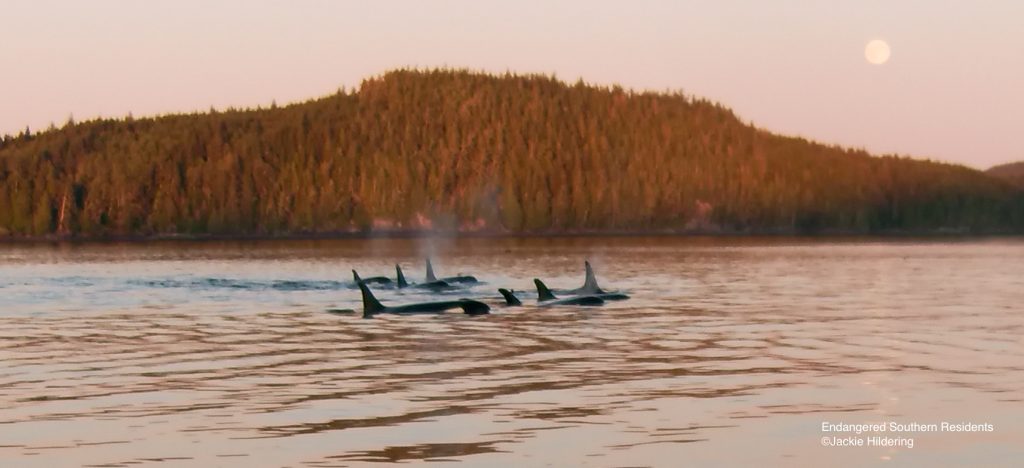
Approximately 73 endangered Southern Resident killer whales remain. Increased protection is necessary to reduce the risk of extinction.
Vessel noise and disturbance can interfere with Southern Residents’ ability to communicate, navigate, and find food. Reducing these disturbances is necessary for their recovery.
Recent research shows that there are adverse effects of vessel noise and disturbance on Southern Resident killer whales at distances well beyond the previous 400 m approach distance (Independent Science Panel on SRKW Recovery). This includes reduced prey capture (Holt et al. 2021 and Tennessen et al. 2024) and impaired ability to communicate and use echolocation (Burnham et al. 2023).
This amendment also brings minimum approach distance from Southern Resident killer whales into alignment with the law in Washington State (1,000 yards), ensuring that approach distance is the same throughout the transboundary habitat of Southern Resident killer whales.
What You Can Do:
Submit comments to the Government of Canada via this link before April 21, 2026, at 11:59 pm EDT. There are 11 sections in the document where comments can be submitted. You may choose to comment on only select sections (e.g., focusing on the section with the title “Add a comment for the General Comment section” or “Add a comment for the Amendments”).
A summary of our comments is provided below and can be copied or adapted for your submission.
Summary of the Marine Education and Research Society’s comments on the Regulations Amending the Marine Mammal Regulations (Southern Resident Killer Whale Approach Distance)
Science indicates that the greatest threats to the endangered Southern Resident killer whale population are the synergistic effects of acoustic and physical disturbance, prey availability, and contaminants.
Reducing vessel presence near Southern Resident killer whales is therefore critical to their protection and conservation. Increasing the approach distance from 400 to 1,000 metres for both motorized and non-motorized vessels is intended to reduce noise and other disturbance that increase stress and impair the ability to forage successfully.
This change would also align the approach distances from Southern Resident killer whales throughout their range (rather than being 400 metres in southern BC coastal waters and 1,000 yards in Washington waters).
For this to be effective, the following is needed:
1. Clarity and Legal Robustness
Vessels in transit and stationary vessels
The proposed amendments to the Marine Mammal Regulations state that approach distances “do not apply to vessels in transit or stationary vessels.”
Clear legal definitions of “vessel in transit” and “stationary vessel” are essential.
In the court case REX v. STEPHEN MICHAEL WHITE, it became evident that “vessel in transit” lacks a legal definition. Without such definitions, loopholes remain that may increase disturbance and complicate enforcement.
For example, those operating maliciously with regard to approach distances could claim they were “in transit” while too close to whales or “stationary” after positioning in the whales’ path.
“Some vessels”
The current language in the proposed amendments references that the 1,000 m distance is to mitigate physical and acoustic disturbance to Southern Resident killer whales “from some vessels”. The term “some vessels” adds ambiguity and should be clarified. The regulation should apply to all vessels (with clearly defined exceptions), not “some vessels.”
Alignment and transparency with other protective measures
There must also be clear alignment and transparency between:
- The Marine Mammal Regulations under the Fisheries Act; and
- Any remaining measures under Transport Canada’s Interim Orders.
While moving the approach distance into permanent regulations is beneficial, it is unclear which additional protections will remain under the Interim Orders. This lack of clarity risks continued confusion and reduced compliance.
Protection would be weakened if Interim Orders no longer include:
- Vessel-restricted zones;
- Speed restrictions;
- Oversight of ecotourism;
- Prohibitions against positioning vessels in the path of killer whales.
The April 2 announcement of the 2026 Interim Order from Transport Canada includes “Whale watching and eco-tourism companies are no longer required to obtain a Whale Watching Authorization…” whereby there is no longer oversight, including mandatory reporting of sightings of Southern Residents through the WhaleReport (WRAS) application. The 2026 Interim Order also makes no mention of the prohibition against “positioning in the path” of whales.
The prohibition against “positioning in the path” should be:
- Clearly defined; and
- Also incorporated into the Marine Mammal Regulations;
- Expanded to apply to all cetacean species.
2. Resources
Adequate financial and human resources are essential to support the effectiveness of the Marine Mammal Regulations.
The Regulatory Impact Analysis Statement for the proposed amendments states that there will be no additional costs to the government as a result of the increased approach distance of 1,000 metres because there is already coast-wide enforcement of disturbance provisions under the Marine Mammal Regulations.
The assumption of no additional costs is extremely unrealistic given current enforcement and education gaps, and that knowledge of, and compliance with, the 1,000 metre rule will require increased resources.
A 2024 survey of approximately 4000 British Columbian recreational boaters conducted by the Marine Education and Research Society identified confusion about differing approach distances and regulations as a key barrier to compliance.
Without addressing this confusion, increased approach distance alone is unlikely to achieve the intended reduction in disturbance.
- Increasing the approach distance will require significant resources not only to inform the public of the regulatory change, but also to provide practical guidance and tools on how boaters can determine whether they are within 1,000 metres of Southern Resident killer whales.
- Resources are also needed for enforcement and legal action to address intentional violations effectively.
- It is also essential to invest resources into building understanding of why approach distances from whales are critical and to foster a culture of voluntary compliance among boaters (rather than relying primarily on punitive measures).
3. Additional Amendments
These proposed amendments to the Marine Mammal Regulations focus only on Southern Resident killer whales.
Protections should also be updated for other at-risk marine mammal populations. By addressing only one species or population at a time, this regulatory amendment process is inefficient and does not support a holistic approach to marine mammal conservation in Canada.
The Government of Canada received feedback on needed protections for other at-risk marine mammal species through the national survey on the Marine Mammal Regulations (June 3 to September 3, 2024). By not acting on this feedback, necessary protections for other at-risk marine mammal species are delayed. This species-by-species approach may weaken protections for other marine mammal species and even unintentionally shift pressures from one at-risk marine mammal species onto another.
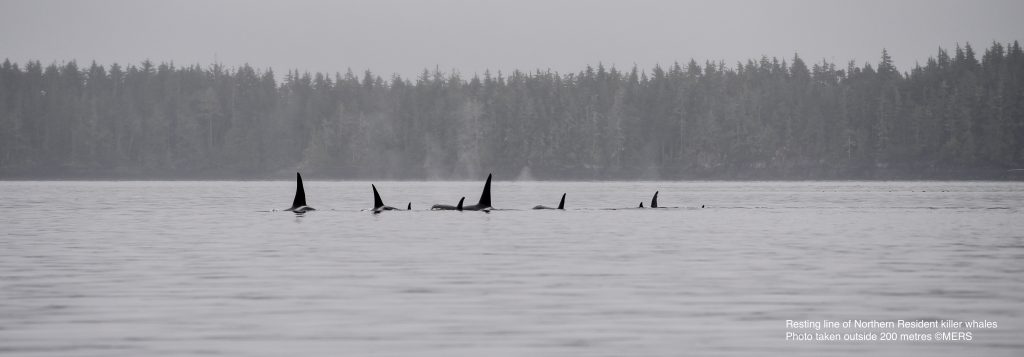
For example, under previous Interim Orders, the minimum approach distance from all killer whales in southern British Columbia was 400 metres. Under the proposed amendments to the Marine Mammal Regulations, focused only on Southern Resident killer whales, the minimum approach distance for other at-risk killer whale populations will revert from 400 metres (under the Interim Order) to 200 metres (under the Marine Mammal Regulations). Both Bigg’s killer whales and Northern Resident killer whales are recognized as threatened populations with necessary protections under Canada’s Species at Risk Act.
As a result, protections for other killer whale populations may effectively be weakened under these amendments. Therefore, a parallel process should be started immediately to consider further amendments in support of protections for other populations.

Links:
- Proposed Amendments to the Marine Mammal Regulations in full: Canada Gazette, Part I, Volume 160, Number 10
- Government of Canada “What we heard report: Marine Mammal Regulations Amendments” (2024 survey)
- Independent Science Panel on SRKW Recovery (2025): Strengthening recovery actions for Southern Resident killer whales
- 2026 management measures to protect Southern Resident killer whales
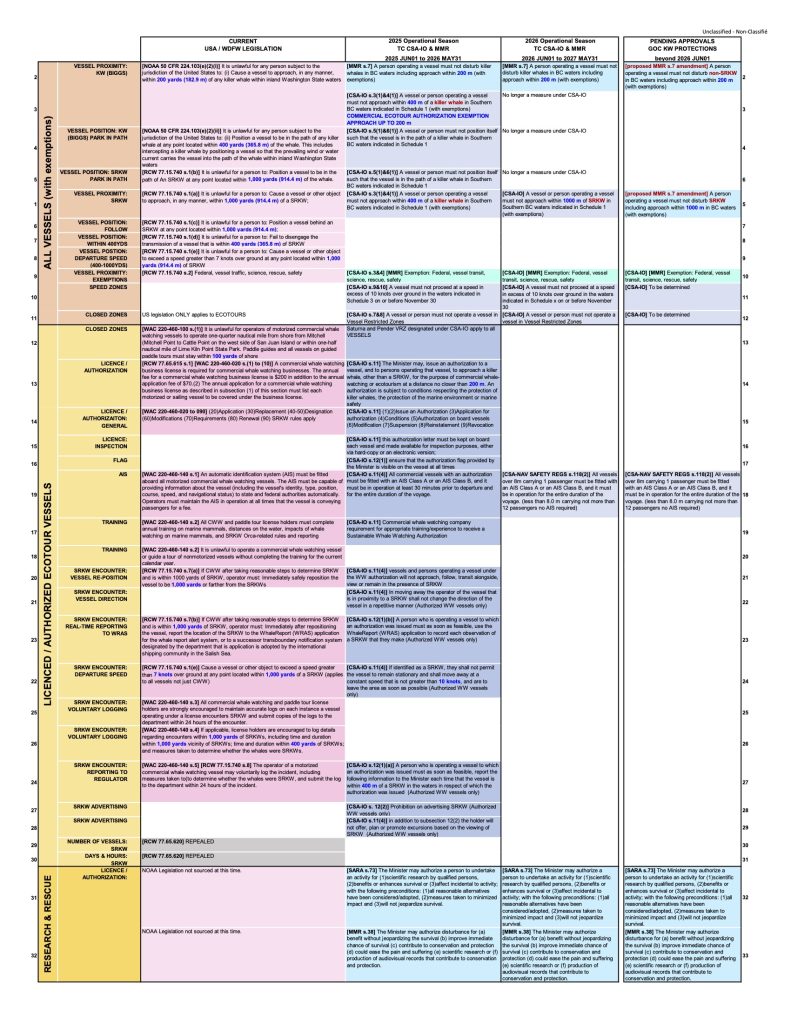
Below is a detailed document (click and download to enlarge) prepared by Fisheries and Oceans Canada (DFO C&P) intended to demonstrate how vessel-related impacts to Killer Whales are managed between Washington State and Canada from an enforcement perspective. It contrasts US Regulations with previous Canadian Management Measures, 2026 Management Measures, and the proposed amendments to the Marine Mammal Regulations.